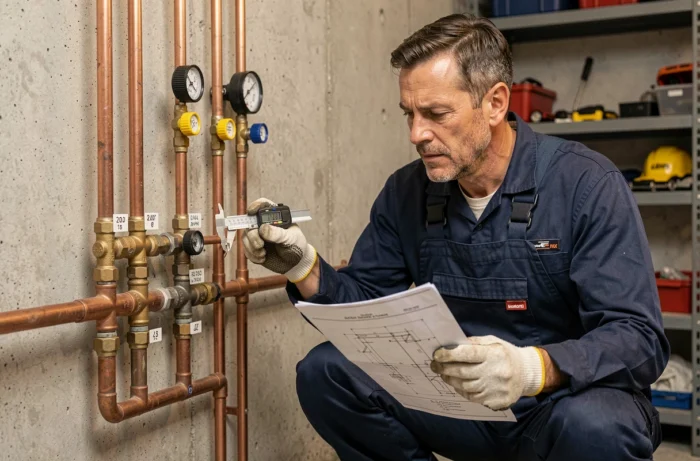
On a construction sites, we often encounter the same problem: a boiler that does not start at full power or a stove flame that is too short, even though the regulator is functioning and the meter is running. In most cases, the pipe is undersized. The diameter of the gas pipes directly affects the flow available to the appliances, and a miscalculation at this stage compromises the safety of the entire installation.
Connected load and simultaneous loads: the real starting point for the calculation
We rarely start with the diameter itself. The first step is to list all the connected appliances and their maximum power: boiler, cooktop, water heater, stove. We add up these powers to obtain the maximum connected load.
Where it gets complicated is in accounting for simultaneous loads. Not all appliances operate at full capacity at the same time. Recent sizing tools require summing the maximum powers, then applying a simultaneity factor to estimate the actual flow that the pipeline will need to support. It is this corrected value that determines the necessary diameter.
The sizing and calculation of gas pipe diameters is based on this logic of weighted accumulation, not on the power of a single dominant appliance.
In practice, in a domestic installation with a boiler and a gas cooktop, the simultaneous load often represents nearly the entire connected load, as both devices frequently operate together in winter. In a collective network with several housing units, the coefficient decreases significantly.
Diameter calculation method: longest-length, branch-length, or equivalent-length
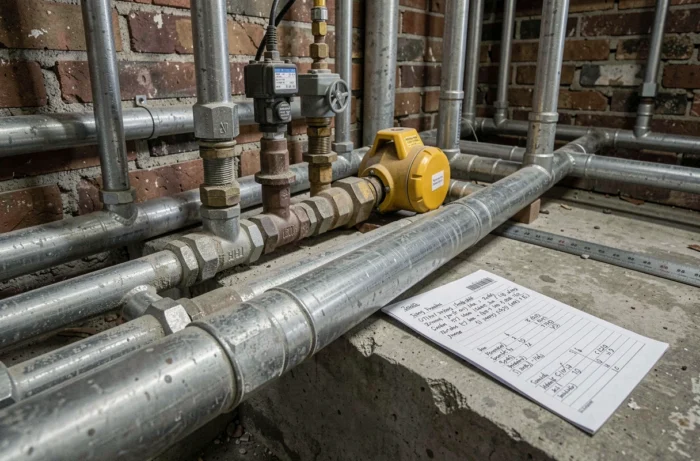
The choice of calculation method is not trivial. There are three main approaches, and the chosen method depends on the applicable regulatory code on the site.
- The longest-length method takes the length of the longest section from the meter to the most distant appliance, then sizes all the pipelines based on this. It is the simplest, but it often oversizes short sections.
- The branch-length method calculates each section independently based on its own length and the flow it supplies. More precise, it allows for smaller diameters on short branches.
- The equivalent-length method incorporates pressure losses related to bends, tees, and valves by converting them into equivalent straight pipe length. It is the most realistic for installations with many directional changes.
In a house with a simple network (meter, one bend, one appliance), the longest-length method is sufficient. As soon as there are multiple appliances spread across sections of different lengths, the branch-length method avoids unnecessarily inflating the diameter and cost.
A practical example to understand
Let’s take the case mentioned by an installer: a buried natural gas pipe about thirty meters long to supply a boiler. With a power of around 25 kW, the calculation yields a diameter of 20 mm in polyethylene. If the required power increases, we move to 32 mm. This jump in diameter is explained by the 1/500 rule, which sets the maximum allowable pressure drop.
The buried PE gas pipe does not withstand UV rays: it must remain underground or be embedded, a point often forgotten during installation.
Available pressure and pressure drop: the two parameters not to be overlooked
The diameter is not chosen solely based on flow. The available pressure at the meter output conditions the entire calculation. The longer the pipeline, the greater the pressure drop, and the larger the diameter must compensate.
Today, variations in allowable pressure are treated as a full design parameter. We no longer reason based on a single standard pressure: recent tools allow for defining a customized value, bounded by regulatory limits, to match the actual network.
For low-pressure natural gas in residential settings, the pressure at the regulator output is generally around 20 mbar. Any excessive loss in line drops the supply pressure below the threshold for proper appliance operation.

Pipe material and its impact on diameter
The material also plays a role. A copper pipe has a different internal roughness than a polyethylene or steel pipe. This roughness affects linear pressure losses: at equal flow, a copper pipe generates less friction than a steel pipe, which can allow for a slightly smaller diameter on the same section.
Feedback on this point varies among installers, but the basic rule remains the same: size first, then check that the chosen material meets the allowable pressure losses for the intended length.
Gas installation safety: sizing errors to avoid
An undersized pipe does not cause a leak, but it starves the appliances of gas. Combustion becomes incomplete, leading to increased carbon monoxide emissions. This is a real and silent risk.
Conversely, excessive oversizing is not dangerous but poses a cost issue and sometimes compliance issues. Standards provide for standardized diameters: one does not choose an arbitrary diameter, one takes the next standardized diameter above the calculation result.
- Check the total power of the appliances before choosing the diameter, not after.
- Include the actual length of the network, bends and fittings included, in the pressure drop calculation.
- Do not mix gas types in the calculation: natural gas and propane have different pressure and flow characteristics.
- Have the sizing validated by a qualified professional, especially for buried or collective installations.
Sizing gas pipes is not an administrative formality. It is the technical foundation that ensures each appliance receives the flow and pressure necessary for clean combustion. A rushed calculation at this stage pays off in performance, consumption, and, in the worst case, safety.