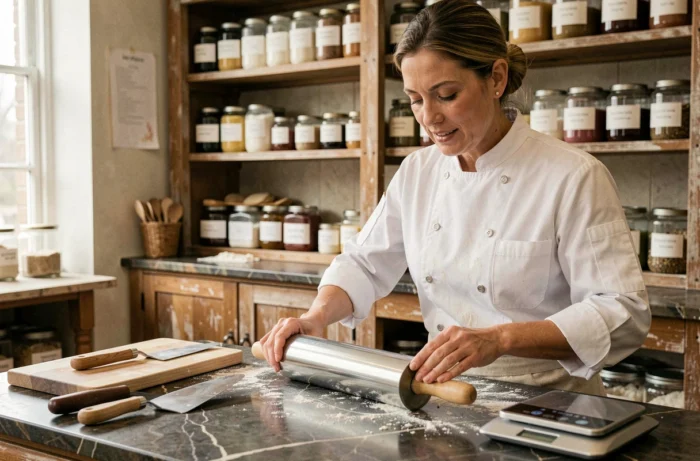
A mixer that overheats the dough, an oven with a probe that drifts a few degrees, a silicone mold that warps during baking: in artisanal pastry, the choice of equipment directly affects the consistency of production. Before making a list of utensils, it’s essential to understand the technical criteria that distinguish reliable equipment from a disappointing purchase.
Regulatory Compliance of Artisanal Pastry Machines
The choice of a mixer, a sheeter, or a professional oven is no longer limited to power and dimensions. The EU Regulation 2023/1230 on machinery, published in the Official Journal of the European Union, is gradually replacing Directive 2006/42/EC. This text redefines safety requirements for equipment used in the food sector.
For a pastry chef, this means ensuring that any new equipment bears a CE marking compliant with updated harmonized standards. Spiral mixers, stand mixers, and deck ovens must meet enhanced protection criteria, particularly regarding transmission components and emergency stop devices.
Buying second-hand equipment without checking its compliance exposes one to rejection during a health inspection or safety check. By consulting the equipment at Mademoiselle Caramel, one can identify references that incorporate these new requirements, simplifying the compliance of the laboratory.
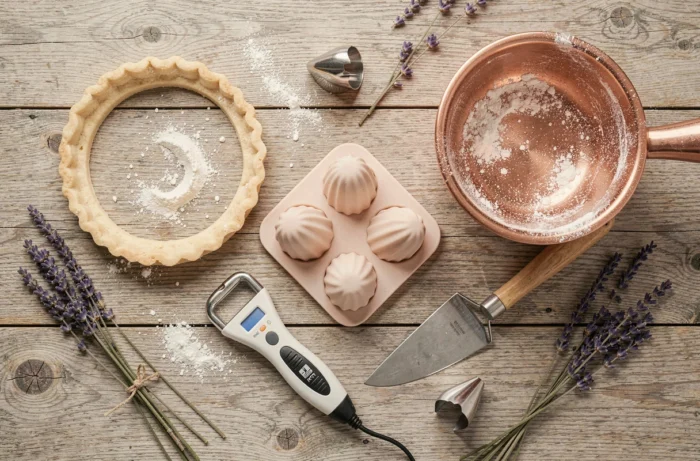
Stainless Steel, Silicone, and Wood: Selection Criteria for Production
Competitors often list utensils one by one without explaining why a material is suitable for a specific use. The determining criterion is not the unit price, but the compatibility of the material with the type of preparation and the frequency of use.
Food-Grade Stainless Steel: The Foundation of the Laboratory
18/10 stainless steel (food standard) resists fruit acids, thermal shocks, and repeated machine washes. For mixing bowls, gastronorm containers, and work surfaces, stainless steel remains the default choice in artisanal production. A stainless steel mixing bowl does not react when in contact with lemon juice or vinegar, unlike untreated aluminum.
Platinum Silicone and Baking Molds
Not all silicone molds are created equal. Only platinum silicone (platinum-catalyzed) guarantees sufficient thermal stability for prolonged baking without deformation or migration of compounds into the dough. Cheaper peroxide silicone molds may emit an odor at high temperatures and lose their rigidity after a few dozen cycles.
To check the quality of a mold, one can pinch and twist it: platinum silicone returns to its shape without whitening. Peroxide silicone shows a white mark at the fold.
Wood: Rolling Pin and Shaping Board
The beech wood rolling pin is still preferred by many artisans for working with shortcrust and puff pastry. Wood slightly absorbs flour, which limits sticking without adding fat. However, wooden cutting boards should be reserved for dry shaping: HACCP standards require washable and non-porous surfaces for any contact with wet ingredients.
Pastry Oven: Technical Parameters to Check Before Purchase
The oven represents the heaviest budget item in a laboratory’s equipment. Two technical parameters are often underestimated during selection.
The consistency of temperature is more important than maximum power. A deck oven with a temperature difference between the top and bottom of the chamber exceeding a few degrees will produce uneven baking on macarons, éclairs, or génoises. Convection ovens compensate better for these discrepancies but can dry out delicate pastries if the fan speed is not adjustable.
The second parameter to examine is the steam capacity. For pastries, brioches, and certain specialty breads, steam injection at the beginning of baking conditions the crust. An artisanal oven without a steam system requires workaround solutions (water tray, sprayer) that remain imprecise.
- Check the temperature difference reported by the manufacturer between different zones of the baking chamber, and request a probe reading if possible.
- Prefer a model with variable speed ventilation to adapt the airflow to the type of pastry (éclairs, meringues, puff pastry).
- Ensure that the steam system is integrated and not optional, especially if production includes pastries.
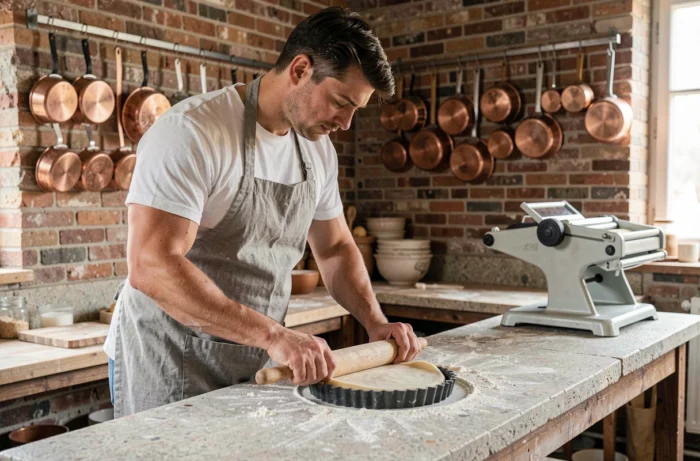
Small Precision Equipment: Scale, Thermometer, and Piping Bag
Pastry relies on strict measurements. Three precision tools deserve thoughtful investment rather than a bargain purchase.
The precision scale should display weight to the nearest gram, with a sufficient capacity to weigh both gelatin and flour in quantity. Dual-range models (0.1 g precision up to 500 g, then 1 g up to 5 kg) cover most artisanal needs.
The probe thermometer is the only reliable way to monitor sugar syrup, caramel, or chocolate tempering. Infrared thermometers provide surface temperature, not core temperature: they do not replace the probe for cooking creams or bombe mixtures.
- Choose a probe with a fast response time (a few seconds) to track the temperature rise of cooked sugar without burning.
- Opt for reusable polyurethane piping bags instead of coated fabric ones, which clean better and do not retain odors.
- Plan for at least three basic nozzles (plain 8 mm, plain 12 mm, fluted) to cover the plating of éclairs, choux, and cream decorations.
The French market for artisanal equipment, supported by a network of over 50,000 bakeries and pastry shops recorded by INSEE in 2025, is driving demand for more robust and better-calibrated tools. Investing in the durability and technical compliance of a small number of well-chosen pieces is cheaper in the long run than replacing fragile equipment every two years.