
A personalized cup is a reusable container on which a company prints its logo, a message, or a visual. This advertising medium serves a dual purpose: it is used daily (coffee break, event, seminar) while promoting the brand’s visual identity with each use. With the implementation of the European PPWR regulation on August 12, 2026, the personalized reusable cup transitions from a simple promotional gadget to a tool for regulatory compliance.
Personalized cup and PPWR regulation: what the European regulation changes
Most articles on promotional cups focus on brand visibility. They overlook a structural change: the European legal framework now imposes concrete obligations on companies that use packaging, including cups.
The PPWR (Packaging and Packaging Waste Regulation) stipulates that starting from February 12, 2027, customers must be able to bring their own container. Then, from February 12, 2028, professionals must offer a reusable option for hot and cold beverages within an operational reuse system.
A technical point deserves to be highlighted: a single-use cup simply labeled “reusable” is not enough. The regulation’s guidelines require a real return, reconditioning, and rotation system. In other words, the cup must be designed for deposit or washing, not just relabeled.
For a company organizing internal events or participating in trade shows, investing now in personalized reusable cups anticipates these obligations. The cup then becomes a communication medium that simultaneously meets a regulatory constraint.
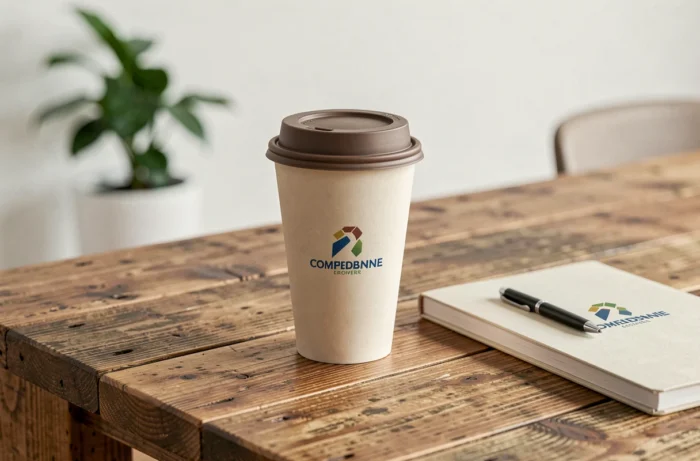
Printing surface and lifespan: the visibility mechanisms of the promotional cup
Adopting the personalized cup for corporate communication relies on a simple mechanism: an object used daily repeatedly displays the logo, without additional effort from the brand.
Unlike a flyer or a business card, the cup has a long functional lifespan. A reusable polypropylene cup withstands dozens of washing cycles without significant degradation of the print, provided the printing technique is appropriate.
Printing techniques and visual durability
Not all prints are equal. Three parameters determine the longevity of the visual on a reusable cup:
- Screen printing deposits thick layers of ink directly onto the plastic, offering good wash resistance and vibrant colors, suitable for simple logos with few colors.
- Digital printing (or four-color printing) allows for complex visuals, gradients, and photos, but the longevity may be lower if the protective varnish is insufficient.
- Pad printing is suitable for small curved surfaces and atypical-shaped objects, with high precision on reduced areas.
The choice of technique depends on the desired visual and the number of colors. For a two-tone corporate logo, screen printing remains the standard. For a detailed event visual, four-color printing is necessary despite a slightly higher unit cost.
Personalized cup in events: beyond the logo on an object
Distributing a branded cup at a trade show or seminar is not just about giving a gift. The cup creates a physical interaction with the brand that digital cannot replicate. The participant holds the object, uses it during the event, and takes it home.
This tactile dimension explains why the personalized cup retains a place in communication budgets while many promotional items (pens, keychains) quickly end up forgotten. A good-sized cup finds its place in a kitchen cupboard or on a desk.
Adapting the cup to the context of use
A common mistake is to order a single model for all uses. A 25 cl cup is suitable for a wine tasting at a trade show but will seem too small for a music festival where participants expect a 33 cl format or larger.
Similarly, the material matters. A reusable rigid plastic cup works for an event with a deposit system. A personalized cardboard cup, however, remains relevant for serving hot beverages in a daily professional setting, provided its compliance with the new PPWR packaging requirements is verified.
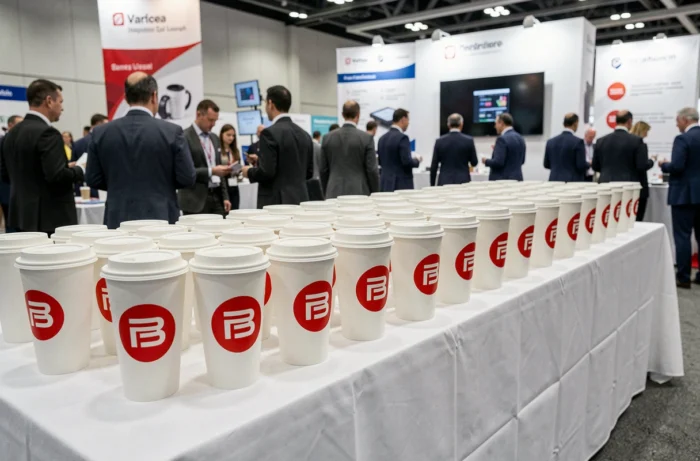
Real cost of the personalized reusable cup compared to disposable alternatives
The reusable cup costs more per unit than a disposable cup. This arithmetic fact masks a more comprehensive calculation.
A disposable cup is purchased, used once, and thrown away. The cost multiplies by the number of uses. A reusable cup amortizes its purchase price over dozens of uses, which shifts the economic balance in favor of a company that regularly organizes events or manages a break room from the first months.
The deposit system adds an interesting financial mechanism: participants pay a deposit that they recover by returning the cup. Unreturned cups are paid for. Retrieved cups are washed and reused. In both cases, the company controls the cost.
Additionally, there is the regulatory dimension. With the obligation to offer reusable containers starting in 2028, companies that have not implemented a system will have to invest urgently, likely at a cost higher than that of a planned transition.
Choosing a personalized cup: technical criteria to check
Before placing an order, a few technical points can prevent disappointments:
- Check that the supplier offers a reuse system compliant with the PPWR (return and reconditioning system, not just a washable cup).
- Request a printed sample and subject it to several washing cycles to test the durability of the visual.
- Confirm the appropriate capacity for the intended use (hot, cold, alcoholic beverage).
- Ensure that the material is food contact compatible and that certifications are up to date.
The personalized cup remains one of the few promotional items that combines daily utility, repeated visibility, and compliance with new environmental requirements. European regulation accelerates this convergence between communication and responsibility, and companies that equip themselves now turn a regulatory constraint into a brand advantage.