Changing home insurance, declaring work, contesting a property tax: we often accumulate several files related to the house without knowing which counter to start with. Online platforms now allow us to group these administrative procedures and track each file from a single space, without travel or postal mail.
Time wasted on home procedures: what gets stuck in daily life
We know the situation: water damage on a Monday morning, a declaration to send to the insurance, a report to fill out, a contractor to contact, then the town hall for a possible work permit. Each contact requests different documents, in different formats, through different channels.
The problem is not the complexity of an isolated file. It’s the accumulation of micro-procedures that are unrelated that creates the burden. We forget a supporting document, we follow up by phone, we lose track of a request sent three weeks earlier.
Feedback varies on this point, but many homeowners and tenants report that the most frustrating aspect remains the lack of visibility: impossible to know if the file is progressing or sitting in a pile. An online platform first addresses this tracking issue before even simplifying data entry.
To centralize information related to home management, one can access Equivok online and find useful resources in one space.
Documents to gather for an online housing file
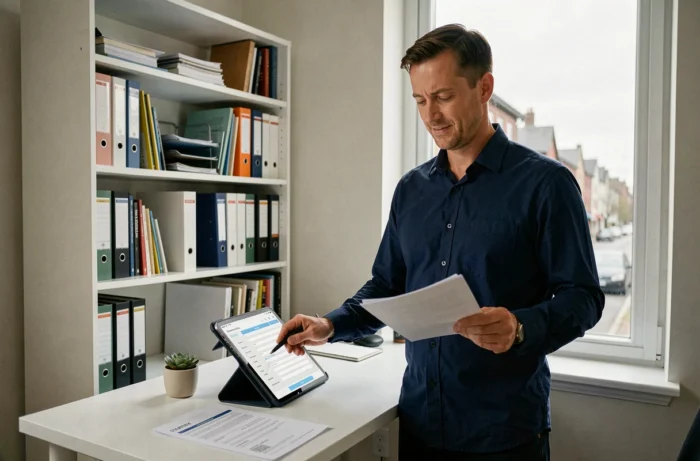
Before starting a procedure on a platform, it is advisable to prepare a reusable document base. Most procedures related to the home require the same basic documents, which can be digitized once and for all.
- Valid identity document (national identity card or passport), often required for tax declarations and urban planning requests.
- Last tax notice or property tax notice, necessary for rental files, renovation aid, and tax disputes.
- Home insurance certificate and contract number, required for any claim, but also for certain condominiums that request them each year.
- Title deed or rental lease, depending on the status, to prove the link with the concerned housing.
Storing these documents in PDF format in a dedicated folder on your computer (or in the platform’s digital vault when available) saves considerable time. You no longer search, you select.
The specific case of work declared at the town hall
For a prior declaration of work or a building permit, plans and photos of the site are required as a supplement. Municipal platforms now accept the online submission of these documents, provided the requested formats are respected (often PDF or JPEG, with file size limits).
A common pitfall: uploading a low-resolution plan. The reviewing service may reject the file for illegibility, which restarts the processing time from the beginning.
Concrete features that make a difference on a platform
Not all platforms are equal. Some merely replicate a paper form in a clickable version, without any real time savings. Others incorporate mechanisms that change daily practice.
Automatic pre-filling via FranceConnect
FranceConnect, which brings together several tens of millions of users, allows you to pre-fill identity and address fields without re-entering. For a change of address or declaration of rental income, you save several minutes and reduce typing errors that block processing.
Real-time file tracking
The real benefit of a platform is not the form, it’s the dashboard. Knowing that your file has moved from “waiting for documents” to “under review” avoids unnecessary calls to the switchboard. Good online tracking eliminates most phone follow-ups.
Notifications and deadline alerts
For landlords managing a rental property, deadlines accumulate: insurance renewal, rent review, energy performance diagnosis to update. A platform that sends reminders by email or mobile notification helps ensure nothing is overlooked.

Insurance, rental, health: home procedures that can be grouped online
We first think of urban planning procedures when talking about home and administration. But a significant portion of the files concerns home insurance, rental management, and sometimes aspects related to the health of the housing (asbestos, lead, air quality).
Grouping these procedures in a single space avoids juggling between five different sites. You submit the damage report, track the declaration, archive the insurer’s response, all from the same interface.
For rentals, platforms allow you to generate a compliant lease, record the inventory, and track receipts. The documents remain accessible in case of disputes, without digging through email exchanges from several months ago.
Dematerialization and digital divide: the limits to know
Dematerialization is progressing rapidly, but requests made to public agents continue to increase. Within a constant scope of public services, the volume of requests has increased by over 5% between 2021 and 2024 despite the rise of autonomous digital usage. Digitizing a form does not eliminate the need for human support.
For users who are not comfortable with digital tools, some town halls and France Services houses offer in-person support to complete online procedures. Before switching everything to a platform, check that a physical relay exists nearby, especially for complex files (inheritance, land division, tax disputes).
The state is also preparing a cross-ministerial mobile application, tested since early 2026, aimed at grouping the main daily procedures in a single interface. Its generalization to the public is planned for autumn 2026 if the schedule holds.
Centralizing your home procedures on an online platform remains the most direct way to keep control over your files. The gain does not come from a prettier form, but from a space where every document, every exchange, and every deadline are tracked in the same place.