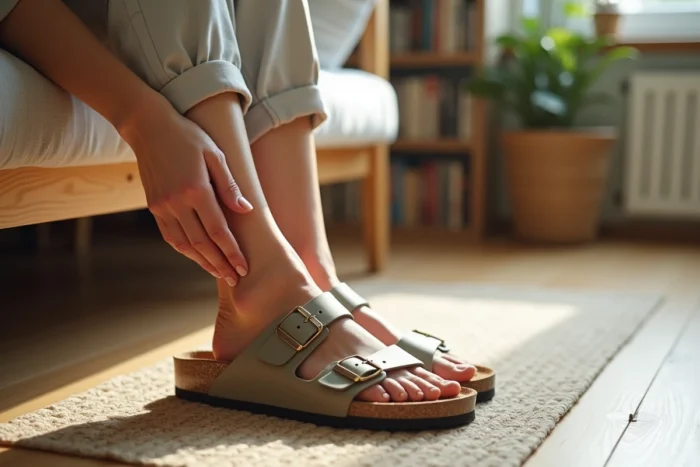
The Birkenstock anatomical footbed rests on a molded cork-latex base that reproduces the plantar impression under load. For a foot with hallux valgus, this architecture modifies the distribution of metatarsal pressures, but its effectiveness directly depends on the morphology of the forefoot and the choice of model.
Cork Footbed and Mechanical Constraints on the First Metatarsophalangeal Joint
The Birkenstock footbed incorporates three support points: a medial arch support, a deep calcaneal cup, and a transverse metatarsal support. This last element redistributes the load upstream of the metatarsal heads, which reduces direct pressure on the bunion area.
We observe that the heel cup stabilizes the rear foot in a neutral position, limiting excessive pronation often associated with the worsening of the big toe deviation. By controlling calcaneal valgus, the footbed indirectly reduces the pull of the adductor tendon on the first phalanx.
A technical point often overlooked: cork gradually deforms under the impression of the wearer. This adaptation creates a personalized support in a few weeks, but it also implies that two asymmetrical feet receive differentiated molding, which benefits patients whose hallux valgus is not unilateral.
To better understand the benefits of Birkenstock sandals for hallux valgus, it is essential to distinguish between symptomatic relief (reduction of pain and friction) and structural correction, which the sandal cannot provide.
Forefoot Width and Strap Adjustability: Selection Criteria for Hallux Valgus
Birkenstock offers two standardized widths, narrow and regular. For hallux valgus, the choice of regular width is almost systematic. The reason is mechanical: the medial exostosis broadens the head of the first metatarsal, and a strap that is too tight directly compresses the bony bump.
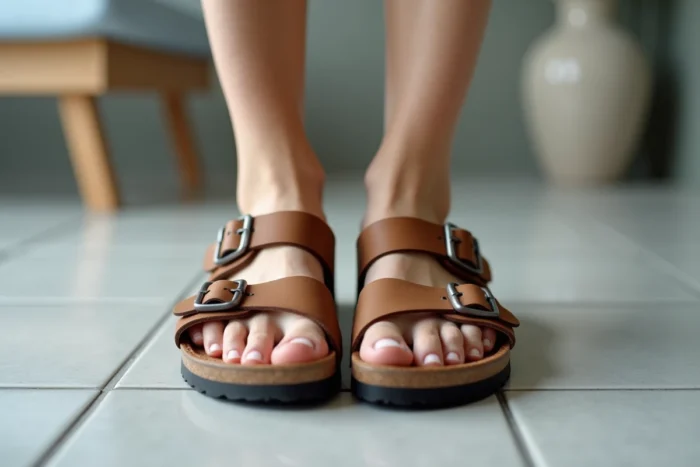
Not all models are equal. Single wide strap sandals on the forefoot (like Madrid) leave the bunion area relatively free, but offer little transverse support. Two-strap models (like Arizona) allow for differentiated tightening: the front strap loosened over the metatarsal area, and the back strap tighter to stabilize the midfoot.
Criteria to check before purchase:
- The front strap must pass over the bump without direct contact with the exostosis. If the buckle is positioned on the bunion, the friction will worsen the inflammation of the bursa.
- The buckle adjustment must offer at least two holes of difference to accommodate variations in foot swelling throughout the day.
- The width of the footbed at the level of the first metatarsal must exceed the width of the foot under load; otherwise, the big toe will spill laterally and lose the benefit of arch support.
A very wide foot with pronounced hallux valgus may not always find a satisfactory fit in the standard range. In this case, opting for open models without a strap on the forefoot, or custom orthopedic shoes, remains preferable.
Birkenstock and Foot Profiles: The Limits of Standardized Relief
We recommend distinguishing three clinical situations. The behavior of the sandal varies significantly depending on the stage of the deformation and the residual joint flexibility.
For moderate hallux valgus with still mobile joints, the Birkenstock provides real relief. The arch support reduces pronation, the footbed absorbs shocks, and the forefoot remains free. Patients generally report a decrease in pain after a few weeks of regular wear.
For rigid hallux valgus with osteoarthritis of the first metatarsophalangeal joint, the cork footbed can become counterproductive. The rigidity of the footbed limits the dorsiflexion of the big toe during the propulsion phase, which increases stress on an already stiff joint. A podiatrist would rather guide toward a rolling bar footbed.
For flat valgus foot associated with hallux valgus, the Birkenstock arch support may prove insufficient. Correcting pronation often requires a custom thermoplastic insole with a medial rear wedge, which the cork footbed does not replace.
Combining Birkenstock Sandals and Orthotic Insoles: Technical Compatibility
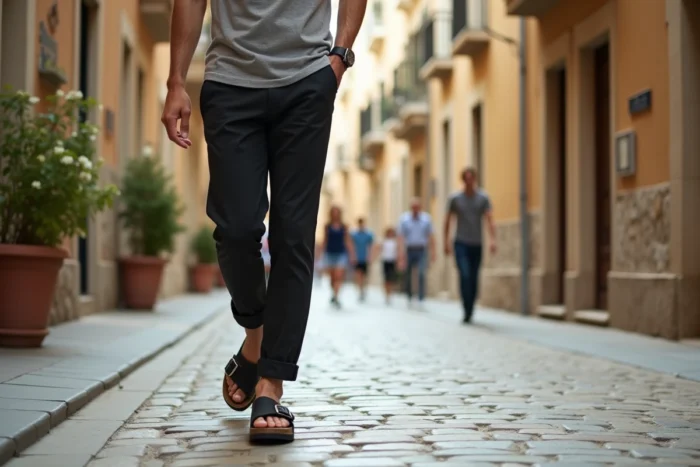
Some patients wish to insert an orthopedic insole into their Birkenstock. This combination poses a volume problem: the integrated footbed already occupies the space intended for the foot, and overlaying an orthotic changes the height of the strap relative to the toes.
Removing the original insole is not possible on classic models with glued cork. However, models with removable insoles (Birkenstock Professional, some closed models) can accept a standard low-profile orthotic.
The most coherent solution for hallux valgus requiring orthotic correction:
- Use the Birkenstock as a comfort sandal at home or for light outdoor use, without additional orthotic.
- Reserve closed shoes with custom orthotic insoles for prolonged walking or sports.
- Have a podiatrist check that the arch support of the Birkenstock does not conflict with the already prescribed correction.
A sandal does not replace orthopedic treatment. It is part of a strategy for occasional offloading. Relief depends as much on the choice of model as on individual morphology, and trying on while bearing weight remains the only reliable way to validate the absence of compression on the bunion area.