
To say “I’m hungry” several times a day eventually loses all impact. French is full of colorful, familiar, or formal expressions to convey that emptiness in the stomach. Here are ten concrete phrases, listed in no particular order, to vary your vocabulary and match the tone of each situation.
Exploring synonyms and alternatives for being hungry allows you to identify very different registers, from childlike language to literary French.
1. To have your stomach in your heels

This is probably the most well-known expression after “I’m hungry.” The image is striking: the stomach has dropped so low that it touches the heels.
It works in almost any context, from family meals to emails between colleagues. Its common register makes it usable everywhere without sounding vulgar or overly formal.
2. To be as hungry as a wolf

The wolf embodies voracity in French tales and proverbs. Saying “I’m as hungry as a wolf” doesn’t just signal hunger: it announces a fierce appetite, almost impossible to satisfy with just a snack.
Just returned from a hike or a workout? This phrase perfectly captures the intensity of the feeling. It is also very popular with children, who immediately visualize the wolf from stories.
3. To be starving

“To be starving” belongs to a familiar, even slang, register. “Dalle” refers here to the throat in old French slang, not the stone of the ground.
Reserve this expression for conversations among close friends or informal messages. In a meeting or facing a client, it would sound out of place. It’s precisely this rawness that gives it its expressive power.
4. To be dying of hunger

The hyperbole is evident, and that’s what makes it effective. No one is actually dying, but the body sends an urgent signal that this phrase dramatizes on purpose.
It can be used both orally and in writing. However, be careful not to use it in a context where real hunger, related to food insecurity, could make the phrase awkward.
5. To have an empty stomach

More descriptive than the previous ones, this expression focuses on the physical sensation. An empty stomach evokes a concrete emptiness, almost audible, that of rumbling.
It fits well in a narrative or storytelling context. A character in a novel “has an empty stomach”; a colleague at the office would rather say “I’m a bit peckish,” a softened version of the same image.
6. To have a little hunger

Indeed, “to have a little hunger” does not describe a ravenous hunger. It’s the light hunger of mid-morning or late afternoon, the kind that calls for an apple or a cookie rather than a full meal.
The nuance is useful. The French language distinguishes degrees of hunger, and choosing the right expression shows that you master these nuances. A “little hunger” reassures: no need for lunch right away, a snack will suffice.
7. The craving

“To have a craving” describes a sudden and intense hunger. The word comes from old French and originally referred to a temporary weakness. Today, it signals a brutal need to eat, often directed towards a specific food.
Nutritionists also distinguish cravings from classic hunger. Physical hunger builds gradually and can be satisfied with various foods. Cravings, on the other hand, arise suddenly and often target sweet or fatty foods, which brings them closer to the emotional hunger described in several recent popular nutrition publications.
8. To smack your lips

Less common, this slang expression deserves to be known. “To smack your lips” means to be very hungry to the point that the jaw clicks in the void, lacking food to chew.
It belongs to the same popular register as “to be starving.” Use it to surprise a conversation partner or add depth to a fictional text. Outside of these contexts, it may seem outdated.
9. To have the munchies

The munchies refer to the canine teeth, the predator’s teeth. “To have the munchies” borrows from animal vocabulary to signify an aggressive, almost impatient hunger.
The expression remains familiar but common among young adults. It conveys urgency well: when you “have the munchies,” patience has already disappeared. It works very well in a quick message or a story on social media.
10. I could eat a horse
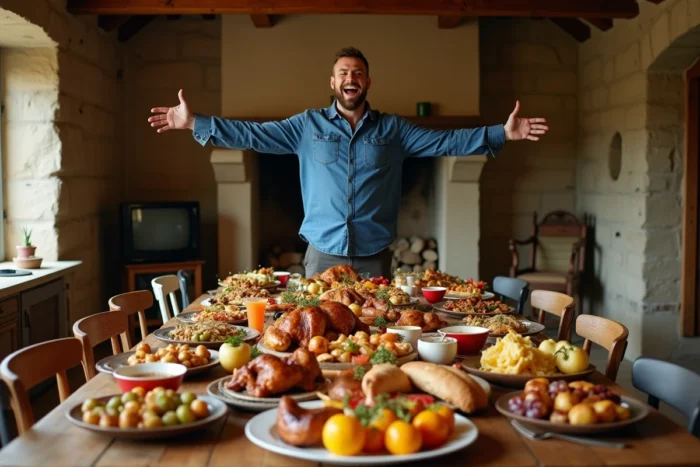
Here’s a hyperbole that brings a smile. The horse, an imposing animal, serves here as a benchmark (no pun intended) to measure appetite. Implicitly: the hunger is so great that no normal portion would suffice.
This phrase works best orally, in family or among friends. It has the advantage of lightening the atmosphere and signaling hunger without dramatizing.
Each expression carries its own language register and degree of intensity. A quick recap to choose the right phrase:
- Formal or neutral register: to have an empty stomach, to be dying of hunger, to have your stomach in your heels
- Common register: to be as hungry as a wolf, to have a little hunger, the craving, I could eat a horse
- Familiar or slang register: to be starving, to smack your lips, to have the munchies
The right word depends on the person in front of you, the channel (oral, written, social media), and the actual intensity of the feeling. Adapting the phrase to the context is what separates functional vocabulary from vibrant vocabulary.