
When you experience irritation after changing your moisturizer, or find yourself with a dull complexion despite a routine of five products, the problem rarely lies in a lack of care. It stems from a poor skin diagnosis. Enhancing your beauty daily relies on targeted actions, not on the accumulation of cosmetics.
Facial care has indeed become the most purchased cosmetic category in France, ahead of perfumes and makeup, according to FEBEA data relayed by Carmel Cosmetics Labs.
Skin diagnosis before beauty routine: the step most people skip
We often start by buying a serum or cream because an online review convinced us. The result: poorly suited products piling up in the bathroom.
Before building a skincare routine, we identify our skin type (oily, dry, combination, sensitive) and especially its current condition. Combination skin in winter does not react the same way as in summer. A nourishing soap will suit a face dehydrated by the cold, but will weigh down oily skin in July.
Testing a product on a small area for three days before incorporating it into your routine avoids most reactions. Apply it behind the ear or on the inside of the wrist. If no redness or tightness appears, you can proceed to the face. This simple reflex saves many consultations with a dermatologist.
To find products formulated for different skin needs, you can browse the selections available on beautyboo.fr, which groups products by skin type and concern.
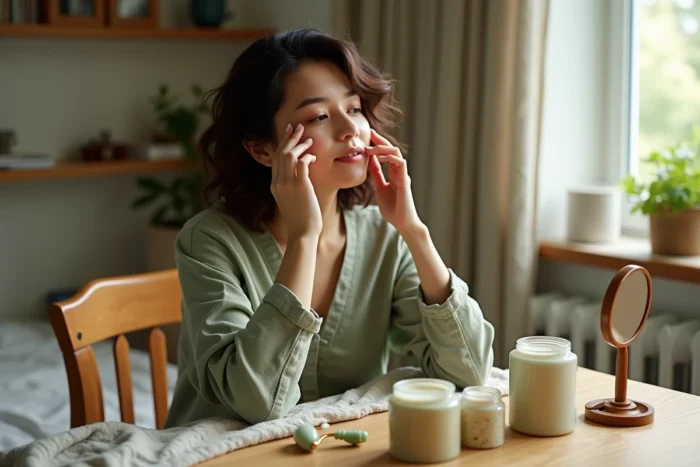
Morning and evening face routine: the steps that really matter
The skincare trends for 2026 are moving away from ten-step routines. The direction taken by new brands prioritizes repairing the skin barrier and respecting the microbiome, rather than layering products.
In practical terms, an effective routine consists of three steps morning and evening.
In the morning: protect and prepare
- A gentle cleanser (gel, foam, or micellar water depending on skin sensitivity) to remove the sebum accumulated overnight without stripping the epidermis.
- An appropriate moisturizing product, such as a light cream or fluid, that maintains the hydrolipidic film throughout the day.
- Sun protection, even on cloudy days, because UV rays penetrate clouds and accelerate skin aging. This is the most cost-effective preventive measure.
In the evening: cleanse and repair
Double cleansing remains the most effective step for a clear complexion. First, remove makeup and greasy residues with an oil or cleansing balm, then follow with a water-based cleanser to eliminate any remaining impurities.
Next, a targeted serum (radiance, anti-spot, deep hydration) penetrates better on clean skin. Finish with a richer night cream than during the day, as the skin regenerates during sleep.
Body care and overall radiance: beyond the face
Focusing solely on the face overlooks the fact that radiance is also visible on the décolletage, hands, and legs. The body deserves regular attention, even if simplified.
Body exfoliation once or twice a week removes dead skin cells and promotes the absorption of moisturizing products. Opt for a fine-grain scrub or a gentle exfoliating glove, avoiding overly abrasive formulas that weaken the skin barrier.
After showering, applying body oil or lotion on slightly damp skin helps seal in moisture. Vegetable oils (sweet almond, jojoba, argan) work well for most skin types. The principle remains the same: hydrate immediately after cleansing.

Diet and hydration: what works from the inside out on the skin
No cream can compensate for an unbalanced diet. What we eat directly reflects on the radiance of our face.
Fatty acids (fatty fish, avocado, nuts) nourish the skin from within by enhancing its elasticity. Antioxidants found in red fruits, citrus, and green vegetables protect cells against oxidative stress.
Regarding hydration, drinking regularly throughout the day maintains the elasticity of the epidermis. This doesn’t mean forcing yourself to drink liters, but rather spreading your intake throughout the day instead of compensating in the evening.
Sleep plays a similarly concrete role. Cellular regeneration primarily activates during deep sleep phases. Sleeping poorly or insufficiently results in a gray complexion, pronounced dark circles, and skin that heals less effectively.
Adapting beauty care to the seasons
A often overlooked point: the routine that works in March may no longer be suitable in August. Heat increases sebum production, while cold dries out the skin barrier.
- In winter, switch to richer textures (balm, creamy cream) and reduce the frequency of exfoliation to avoid weakening skin already stressed by the cold.
- In summer, lighten the textures (fluid, gel-cream) and strengthen sun protection. A thermal water spray in your bag can refresh the face without disrupting makeup.
- During transitional seasons, observe your skin for two weeks before modifying your routine. A sudden change in products causes more imbalances than it resolves.
Adjusting your products every three to four months is sufficient in most cases. There’s no need to replace everything: change the moisturizer and adapt the cleanser, while the rest can remain stable.
Enhancing your beauty daily doesn’t require ten products or an extravagant budget. A short routine, products suited to your skin type and the season, and a diet that supports the skin from within. The most effective approach is often the simplest, provided you start with the right diagnosis.