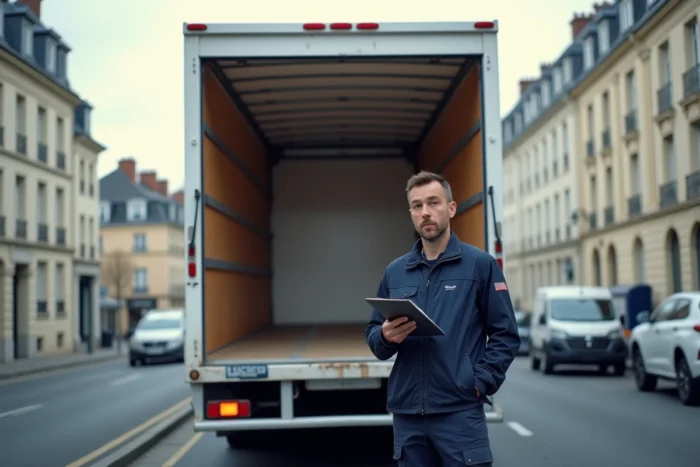
Are you preparing for a move or transporting bulky items and unsure about the right vehicle? The 10 m³ truck often appears in search results, but its actual dimensions and loading capacity remain unclear for many. Understanding what this van can (and cannot) hold avoids unpleasant surprises on the big day.
Actual volume vs. advertised volume: what a 10 m³ really carries
The mention “10 m³” corresponds to the geometric volume calculated from the van’s interior dimensions. In practice, the actually usable volume is around 8 m³. Why this discrepancy? Furniture has irregular shapes, boxes leave gaps between them, and securing fragile items takes up space.
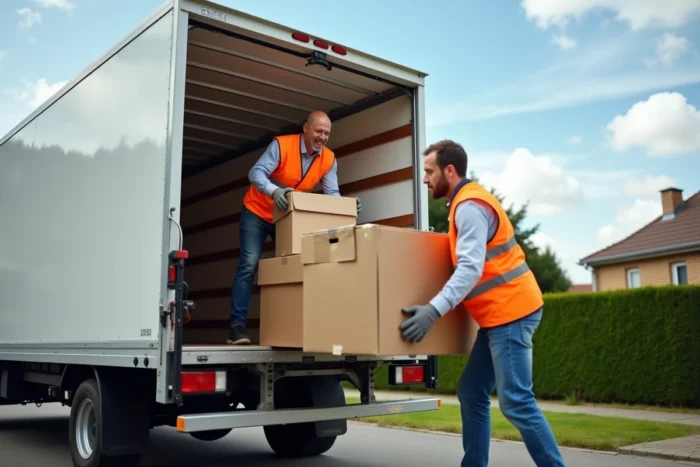
Specifically, a mattress, a two-seater sofa, a refrigerator, a washing machine, and about twenty boxes fit into this volume. This corresponds to the contents of a studio or a small apartment of 20 to 30 m². Beyond that, the load overflows or requires a second trip.
To better assess the capacity and dimensions of a 10 m³ truck, you need to think in terms of useful volume rather than the gross volume displayed by the manufacturer.
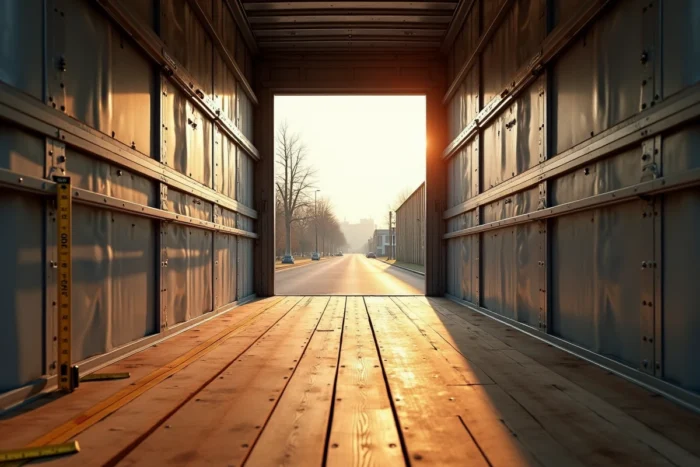
Interior dimensions of a 10 m³ van: length, width, height
The figures vary slightly depending on the models, but the orders of magnitude remain similar from one manufacturer to another.
| Dimension | Interior (indicative) | Exterior (indicative) |
|---|---|---|
| Length | 2.80 m to 3.26 m | about 5.91 m |
| Width | 1.75 m to 1.78 m | about 2.42 m |
| Height | 1.80 m to 1.84 m | about 2.82 m |
The interior height is around 1.80 m. You can therefore stand in the loading area, which makes organizing boxes vertically easier. The width of 1.75 m accommodates a two-seater sofa laid flat without forcing.
What these dimensions imply for furniture
A double bed (140 x 190 cm) fits easily in length. A standard-sized disassembled wardrobe slides along the wall. However, a single piece of furniture longer than 2.80 m will not fit: remember to disassemble bookshelves or tall shelves before loading.
The side opening, present on most models, allows for loading long items without going through the back. This hatch changes the game when you need to slide in a piece of wood or a tabletop.
Payload and GVW: the weight trap in a 10 m³ truck
You may have already noticed that a van’s specification mentions a GVW. This acronym stands for Gross Vehicle Weight, which is the maximum weight the vehicle can reach when loaded, including the driver and passengers.
The payload is calculated by subtracting the empty weight from the GVW. On the registration document, the GVW is listed in section F2, and the empty weight in section G1. For a 10 m³ van, the payload generally ranges between one ton and one and a half tons.
Why weight matters as much as volume
Filling the van to the ceiling poses no problem when transporting boxes of clothes or linens. But books, dishes, or tools take up little space and are heavy. An overly heavy load exceeds the payload well before filling the volume.
Here are the items that quickly add weight to a load:
- Boxes of books: a dozen standard-sized boxes can represent several hundred kilos
- Appliances (washing machine, dryer, dishwasher): each device often weighs between 50 and 80 kg
- Solid wood furniture (buffets, antique dressers) that combine high weight and moderate volume
Exceeding the GVW exposes you to a fine in case of a roadside check and weakens the vehicle’s braking. It’s better to weigh your heaviest boxes before loading and distribute the weight across the loading area.
Driving and maneuverability of a 10 m³ van with a B license
Good news: a B license is sufficient to drive a 10 m³ truck, provided the GVW does not exceed 3.5 tons, which is the case in this segment. No additional training is required.
The exterior dimensions (about 5.90 m long and 2.80 m high) remain manageable in urban areas. The length exceeds that of a large SUV by about a meter, which is particularly noticeable in tight parking spots and roundabouts.
Three reflexes to adopt at the wheel
- Check the height clearance before every underground parking or low bridge: 2.82 m exterior height prohibits certain parking areas limited to 2 m or 2.10 m
- Anticipate braking distances, especially when loaded: a full van reacts more slowly than a car
- Use the side mirrors at all times, as rear visibility is almost nonexistent in a panel van
Fuel consumption in diesel remains moderate for a vehicle of this size. The additional cost compared to a car is largely offset if you avoid a second round trip with a smaller vehicle.
The 10 m³ truck covers most needs for moving a small home or for occasional transport of furniture. Thinking in terms of useful volume (around 8 m³) and payload (one ton to one and a half tons) allows for planning your load without the risk of overloading or running out of space.