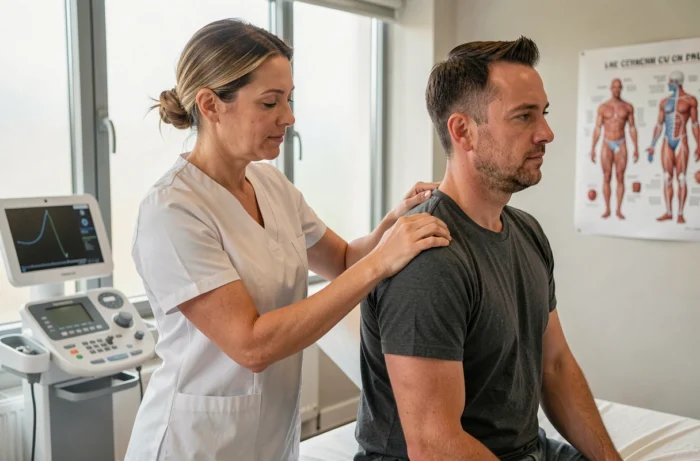
You have been experiencing back pain for weeks and your doctor is referring you to a physiotherapist. The session resembles what you knew ten years ago: massage table, exercises on mats, ultrasound. Except that behind this apparent familiarity, innovations in physiotherapy are profoundly changing the way practitioners assess, treat, and follow their patients.
Direct access to the physiotherapist: what changes concretely for patients
Before discussing sensors or virtual reality, a less visible evolution is transforming physiotherapy in France. Since the law of May 19, 2023, some physiotherapists can perform actions without prior medical prescription, in facilities such as health houses or care centers.
An experiment launched in June 2025 expands this direct access to physiotherapists who are members of territorial professional health communities (CPTS) in 20 departments. Between January 2024 and June 2025, 567,222 actions were billed for direct access, with 40% in the first half of 2025 alone, without an increase in claims reported by Cnam.
In practical terms, this means a time saving for the patient: there is no need to first visit the doctor for an ankle sprain or recent lower back pain. The physiotherapist evaluates, decides on the treatment, and redirects if necessary. Resources published on Physio Mag allow tracking these regulatory developments over the months.
Motion sensors and connected dynamometers in rehabilitation
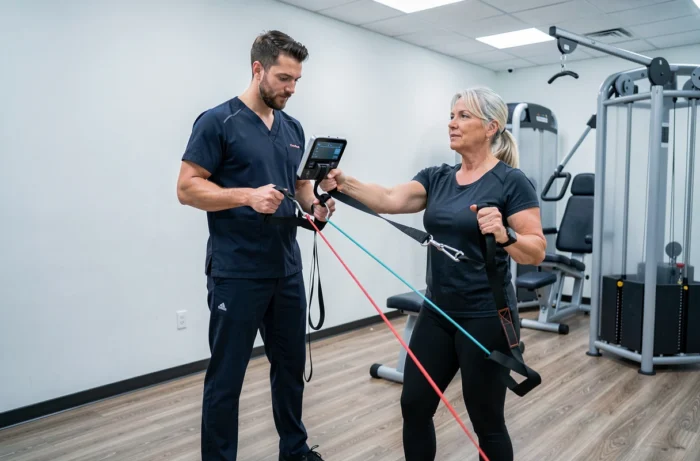
Have you ever noticed that a physiotherapist asks you to raise your arm and notes “correct amplitude” in their file? This visual assessment remains useful, but it depends on the practitioner’s experience. Inertial sensors (called IMU) change the game.
An IMU is a small device attached to a segment of the body (thigh, forearm, ankle). It combines an accelerometer and a gyroscope to measure speed, amplitude, and asymmetries of a movement. Placed on both knees of a patient who has undergone ligament surgery, it detects a difference in strength or mobility between the healthy side and the operated side.
What sensors bring to home monitoring
The interest is not limited to the office. Some wearable devices record the patient’s movements at home. The physiotherapist then retrieves the data and adjusts the program. Monitoring becomes continuous, not limited to sessions.
Connected dynamometers complement this system. They measure muscle strength with a precision that the practitioner’s hand cannot replicate. After a wrist fracture, for example, the dynamometer quantifies the grip deficit week after week.
- Inertial sensors objectify joint amplitude and walking asymmetries, where observation remains subjective.
- Connected dynamometers measure residual muscle strength to adapt the workload in rehabilitation.
- Wearables allow monitoring between sessions, with data that can be utilized by the practitioner remotely.
Virtual reality in physiotherapy: beyond the gadget
Virtual reality (VR) in rehabilitation is not about playing a video game to forget the pain. Its principle is based on immersing the patient in a controlled environment to solicit precise movements.
Let’s take a patient who has suffered a stroke and struggles to raise their left arm. In a VR headset, they grab virtual objects placed at progressively higher levels. The software records each movement, adjusts the difficulty in real-time, and provides immediate visual feedback. The patient sees their progress, which enhances their motivation.
Current limitations of therapeutic VR
Not all clinics are equipped, and the cost of the equipment remains a barrier. VR is not suitable for all profiles: some patients suffer from nausea or disorientation. It complements manual techniques; it does not replace them.
The approach works particularly well in neurology (post-stroke rehabilitation, balance disorders) and in managing chronic pain, where the psychological component of care plays a central role.
My Prevention Assessment: the physiotherapist as a public health actor
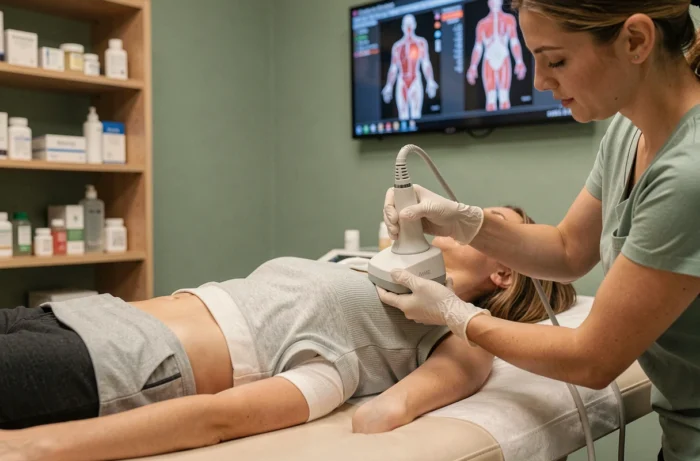
Physiotherapy is no longer just about treating an injury. Since June 2024, the “My Prevention Assessment” program allows French people from four age groups (18-25 years, 45-50 years, 60-65 years, 70-75 years) to review their lifestyle habits and risk factors.
Starting in October 2026, physiotherapists will be able to conduct these assessments. This marks a change in posture: the physiotherapist intervenes before the pain, not just after. Identifying a muscle weakness in a 65-year-old is about preventing a fall and potentially a hip fracture.
- The assessment targets four age groups to tailor prevention to the specific risks of each life stage.
- The physiotherapist evaluates mobility, balance, and physical activity habits during this dedicated appointment.
- This evolution positions physiotherapy as a tool for prevention, not just rehabilitation.
This expanded role requires ongoing training for practitioners. Digital tools (sensors, tele-rehabilitation platforms) facilitate follow-up after the assessment, but the direct relationship between the patient and the physiotherapist remains the foundation of care.
Innovations in physiotherapy are not limited to screens and algorithms. Direct access, structured prevention, and objective measurement tools work together for a more responsive care approach. For the patient, the most tangible change may be the simplest: consulting earlier, being better assessed, and tracking their own progress with concrete data.