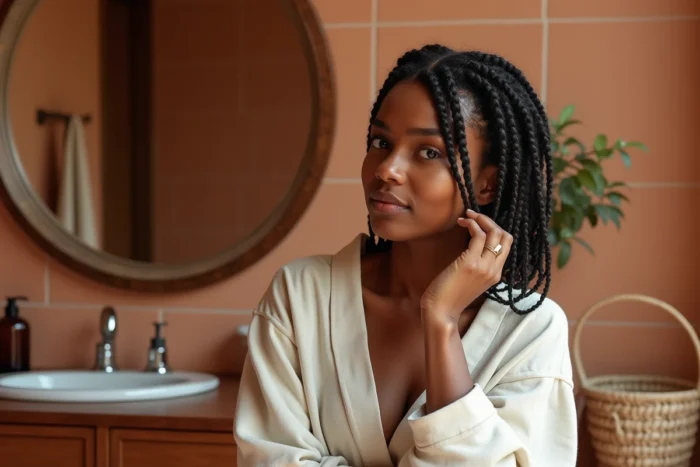
On tightly curled hair that barely reaches a few centimeters, the first constraint is not style, it’s grip. When the strand slips between the fingers on the third pass, we put down the comb and resort to a headband. Braiding without extensions on short afro hair actually requires less length than one might think, provided you choose the right type of braid and prepare the hair beforehand.
Minimum length for braiding on short curly hair
The question comes up at every salon appointment: how many centimeters are needed for the braid to hold without extensions? The benchmarks used by afro hairstylists are becoming clearer. For small braids close to the scalp (fine flat twists, tight cornrows), one generally counts 5 to 7 cm of usable length. For more visible braids on textured hair, the range goes up to 7 to 10 cm.
If the hair tends to slip (low porosity, 4A texture smooth when stretched), it’s better to aim for 12 to 15 cm so that the braid remains stable without being tight. Below 5 cm, flat twists remain the only realistic option for braiding without extensions: they grip the short hair without exerting excessive tension.
To explore different approaches suitable for these lengths, there is a comprehensive overview of afro braiding without extensions on Beauty Girl that details the styles achievable according to hair growth.
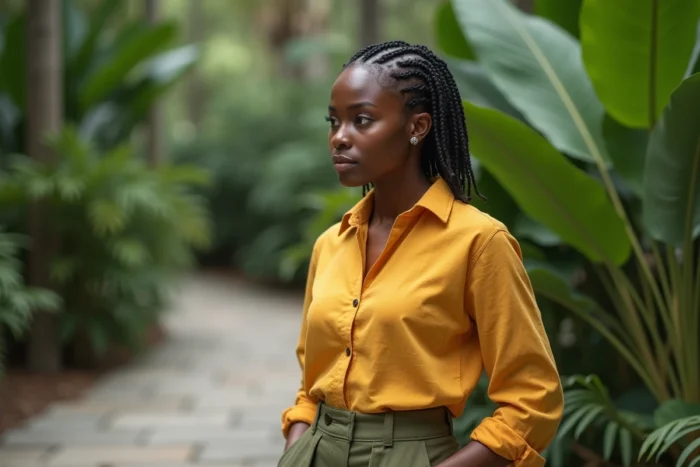
Tension and preservation of the temples in afro braided hairstyles
There is a lot of talk about styles, but rarely about what happens at the scalp level. On short hair, the margin for error is slim: pulling too hard on three centimeters of regrowth at the temples risks traction alopecia in just a few months.
Flat twists: the lowest tension
Flat twists only wrap two strands instead of three. This technique generates low tension, suitable for fragile temples. They can be applied to very short hair without the hairline experiencing marked tension. It’s the go-to hairstyle when classic flat braids pull too much.
Fine flat braids: essential control
Fine cornrows exert moderate to high tension depending on how they are done. The determining factor is not the pattern, but the hand of the braider. On short afro hair, two precautions make all the difference:
- Start each braid with a wide grip (about one centimeter of scalp) and then gradually tighten, rather than starting thin right at the root.
- Avoid picking the same braid line in the same spot at each re-styling. Shifting the line from one week to the next protects stressed areas.
- Deliberately relax the tension on the first two passes at the temples and nape, even if it makes the braid look slightly looser in those areas.
The duration of wear also plays a role. Beyond two weeks without undoing, even a well-placed braid will start to pull on the regrowth. On short hair, it’s better to stick to cycles of ten to fourteen days.
Preparation of short curly hair before braiding
Dry and retracted hair breaks as soon as it’s manipulated. Before braiding, preparation is as crucial for hold as the technical gesture.
Moisturizing and then sealing the night before braiding yields the best results. Apply a water-based leave-in on damp hair, then seal with a thick butter (shea, mango) or vegetable oil. The hair remains supple the next day without being greasy enough to slip between the fingers.
Product recommendations are evolving: flaxseed or acacia gum gels are gradually replacing strong-hold gels that leave sticky residues. The goal is to achieve a gentle grip without stiffening the fiber. On very short natural hair, a too-hard gel prevents the strand from wrapping properly in the braid.
One last often-overlooked point: finger detangling, section by section, before starting. On short curly hair, a wide-tooth comb is rarely sufficient. Microscopic knots at the nape can cause entire strands to give way if forced with a rigid tool.
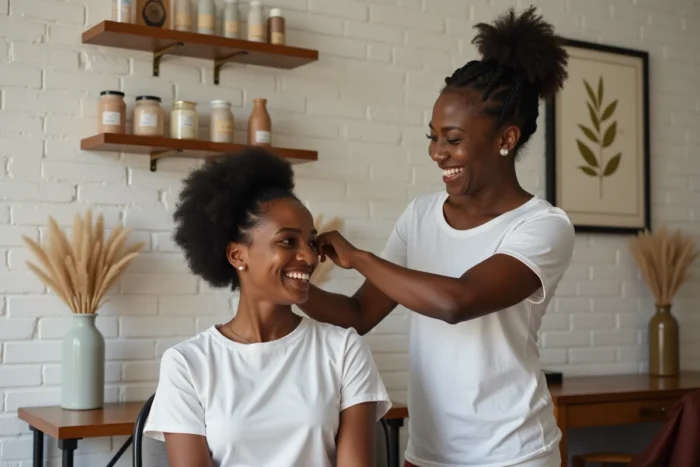
Styles of braids without extensions suitable for short afro hair
Not all patterns work on a few centimeters of hair. Here are three that actually hold without extensions and provide a neat look on short curly hair.
Geometric flat cornrows
The design does all the visual work. Straight all-back lines, lateral zigzags, spirals starting from the top of the head: the pattern compensates for the reduced length of the braids. The more graphic the design, the less noticeable the short ends are. You can vary the thickness of the braids on the same head (thin on the sides, wider on top) to create volume without accessories.
Crossover flat twists on top
Two to four wide flat twists that cross at the top of the head create a polished look in under twenty minutes. This style works even on very short lengths because the flat twist does not require hanging ends. They can be undone in the evening and redone in the morning without weakening the hair, making it a natural everyday hairstyle.
Individual mini twists
Each small strand is twisted onto itself. The result resembles temporary mini locks. On 4B or 4C type curly hair, the texture holds the twist without elastics or setting products. Feedback on hold varies depending on hair density, but generally, mini twists last between five and ten days on short hair before starting to unravel at the ends.
Maintenance of braids without extensions on short afro hair
The hairstyle holds, but the scalp does not. Nightly maintenance makes the difference between neat braids after a week and fuzzy braids by the third day.
- Sleep with a satin bonnet or a silk pillowcase. Cotton absorbs moisture and creates friction that frizzes short braids.
- Spray a mixture of water and vegetable glycerin every other day directly onto the braids, without undoing them. Curly hair loses its moisture quickly, especially when exposed to air.
- Do not oil the scalp every day. An excess of grease on the scalp attracts dust and suffocates the follicle. Two to three applications per week are sufficient.
- Remove the braids by first moistening each section. Undoing dry short curly hair breaks the ends and pulls out knots formed during wear.
Post-braiding care is as important as the installation. A light protein mask after each cycle of braids helps to compensate for the loss of keratin due to repeated manipulation. On short hair in the growth phase, this step prevents the hair from becoming porous and brittle before reaching the desired length.