
We often buy our first pair of running shoes based on feeling, depending on the color or price. Then, after three weeks, a knee starts to ache, a toenail darkens, or the sole compresses like wet cardboard. The problem rarely comes from the training volume. It comes from the shoe, which is poorly suited to the foot that wears it.
Width of the forefoot and foot volume: the criterion that shoe size does not measure
Most runners focus on the length of the shoe. They take their usual size, sometimes add half a size, and consider the matter settled. However, the real point of friction is at the front of the foot, at the level of the toebox.
A forefoot that is too narrow compresses the toes with every stride. On a long run, this repeated compression causes chafing, blisters, or even black toenails. Several recent guides emphasize that a running shoe must allow the forefoot to spread naturally, with enough space to move the toes without lateral constraint.
The width of the foot is measured, not just the length. You can do this at home with a piece of paper and a pencil, tracing the outline of the foot while bearing weight. The gap between the inner edge and the outer edge provides a reliable indication. Some brands now offer models in various widths (standard, wide, extra-wide), which allows for a more refined choice well beyond just the shoe size.
To delve deeper into this point and other selection criteria, the running guide from Carnet de Sportive details the steps to follow based on your morphology and practice.
Trying on running shoes: why the time of day changes everything
We’ve all tried on shoes in the morning at the store, found the perfect pair, and then felt our toes compress during the first run at the end of the day. This is not a manufacturing defect.

The foot naturally swells over the hours, and even more under effort. Trying on your shoes at the end of the day replicates the actual volume of the foot during running. This rule may seem trivial, but it avoids sizing errors that neither the brand nor the seller can correct afterward.
During the fitting, wear the socks you use for running. Lace them normally, not too tightly, and walk for at least five minutes. If the heel slips or the forefoot bumps against the upper, move on to another model. Immediate comfort remains the best indicator: a shoe that requires “breaking in” is a poorly fitting shoe.
Drop of running shoes: adapt the transition, don’t change abruptly
The drop is the height difference between the heel and the forefoot. A high drop (around 10-12 mm) favors a classic heel strike. A low drop (under 6 mm) brings the stride closer to a midfoot or forefoot strike.
Competitors often present the drop as a simple comfort choice. In practice, it is a biomechanical parameter that alters the strain on the Achilles tendon, calves, and knees. Suddenly switching from a high drop to a minimal drop exposes you to injuries, particularly tendinopathies.
The current recommendation in specialized guides for 2025-2026 goes in the same direction: you decrease in increments, not all at once. If you’ve been running for two years with a 10 mm drop, switching to 4 mm overnight stresses muscle and tendon structures that are not prepared for it. It’s better to reduce by 2 to 3 mm per pair over several months, gradually integrating the new shoe into the rotation.
Rotation of running shoes: alternating two pairs for longer durability
Running always with the same pair seems logical for cost-saving. In reality, this habit accelerates the wear of the midsole and reduces the overall lifespan of the shoe. The cushioning foam needs time to regain its properties after each run.
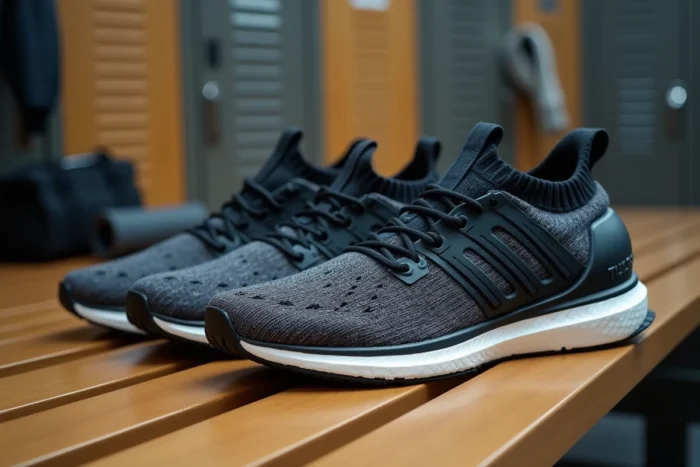
Alternating between two distinct pairs offers a double advantage:
- The foam of each pair recovers between sessions, which significantly extends the lifespan of the cushioning.
- Varying the drops and sole profiles stresses the foot differently, reducing the risk of injury from repetitive overload on the same structures.
- You can adapt the shoe to the session: a more cushioned pair for long runs, a lighter and more responsive pair for intervals or speed sessions.
This is not a luxury reserved for dedicated runners. Even with two outings per week, alternating between two complementary models makes a real difference in comfort and equipment longevity.
Stride and foot type: what you can check yourself
Universal, pronator, supinator: these terms come up everywhere. You find them on product sheets, in store advice, on forums. The problem is that many runners do not know which category they fall into and buy a “neutral” shoe by default.
Before diving into a complete podiatric analysis, you can observe the wear of your old shoes. Significant wear on the inner edge of the sole suggests pronation. Wear concentrated on the outer edge points to supination. Even wear under the forefoot corresponds to a neutral stride.
This observation does not replace a professional assessment, especially in cases of recurring pain. Feedback varies on this point: some runners do very well with a neutral shoe despite slight pronation, while others need a stabilizing model to run comfortably. The type of stride guides the choice, but the feel during the run remains the final judge.
The choice of a pair of running shoes is based on concrete criteria: the actual width of the foot, the timing of the fitting, the gradual management of the drop, the rotation between two models, and the observation of one’s own stride. No online algorithm will replace testing in real conditions, with laces tightened, swollen feet, on the type of surface where you actually run.