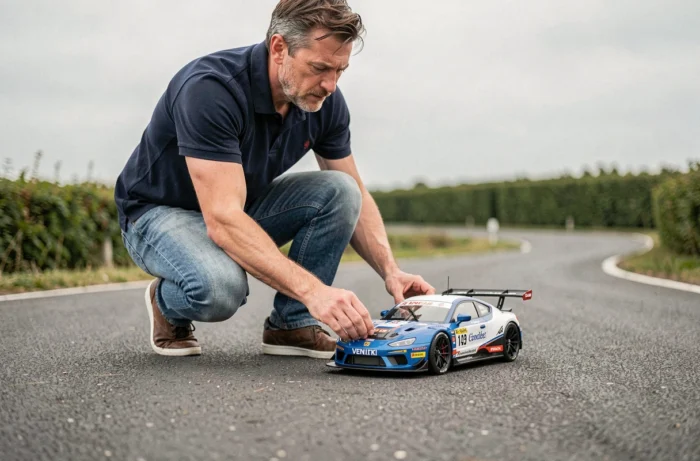
RC car modeling in Vendée is not just about driving a small car in a garden. Behind the remote controls, there are enthusiasts who adjust suspensions, choose between brushless and nitro engines, and meet on tracks made of dirt or asphalt. This technical hobby, accessible from adolescence, structures an active community in the department, with informal outings and organized races.
Brushless or nitro engine: the choice that determines the entire RC practice
Have you ever heard the high-pitched whine of an RC car launched at full speed in a parking lot? This characteristic sound comes from a brushless motor, which is an electric motor without brushes. It is now the most common type of motor in RC racing.
The brushless motor offers near-instant acceleration and requires very little maintenance. No spark plug to change, no carburetor adjustments. You charge the battery, you drive. For a beginner, it’s the simplest entry point.
The nitro engine, on the other hand, operates with a mixture of methanol and oil. It produces a deep sound, a smell of combustion, and requires fine-tuning at each outing. The nitro attracts drivers who love mechanics as much as driving. The downside: a significantly higher noise level, which raises questions about time slots and authorized practice locations.
In Vendée, clubs and groups of enthusiasts organizing outdoor outings increasingly favor brushless, particularly to limit neighborhood conflicts related to noise. Since the decree of July 7, 2023, setting thresholds of 85 dB(A) during the day as part of the sound radar experiment, acoustic monitoring has been strengthened in municipalities, even for leisure activities.
The Racing Car Yonnais club, based in La Roche-sur-Yon, brings together drivers practicing on different types of terrains and RC vehicles. Their activities are detailed on https://www.racing-car-yonnais.fr/, which presents the race categories and club meetings.
RC models to start in Vendée: Traxxas Slash, Tamiya, and all-terrain alternatives
Choosing your first RC vehicle can seem complicated given the available options. Two brands dominate conversations in Vendée clubs: Traxxas and Tamiya.
The Traxxas Slash remains the reference for short course, this discipline where lowered trucks compete on tracks combining dirt and jumps. The Slash is available in brushless (VXL) or brushed (more affordable) versions. Its robustness is its main asset: spare parts are easy to find, including online.
Tamiya, a historic Japanese manufacturer, offers kits to assemble yourself. The approach is different: you assemble the chassis, choose your accessories, and paint the body. Building a Tamiya kit means understanding each part before driving. This approach appeals to modelers who want to master the mechanics of their vehicle.
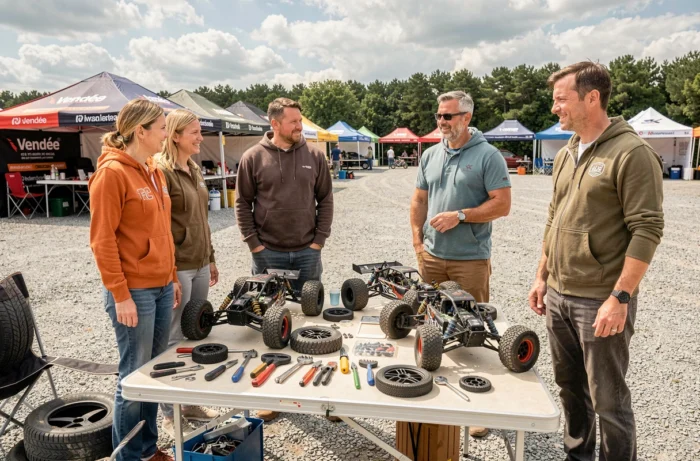
For off-road and crawling (crawler), the TRX-4 models from Traxxas are very present in Vendée outings. These vehicles replicate scale 4x4s and are driven at low speeds on natural courses: rocks, roots, muddy slopes.
- Short course (Slash, truck): speed and contact on prepared tracks, ideal for first competitions
- Crawler and scale (TRX-4, SCX10): technical crawling in natural environments, slow pace and precision driving
- Brushless buggy and truggy: races on all-terrain tracks with jumps, suitable for intermediate drivers
- RC drift on asphalt: controlled slide driving, practiced indoors or on smooth parking lots
Adjustments and maintenance: what makes the difference between driving and piloting
Buying a good model is not enough. Most regular RC drivers spend as much time adjusting their vehicle as they do driving it.
The suspension geometry determines cornering behavior. By adjusting the camber (the angle of the wheels relative to vertical) and toe (the angle of the wheels viewed from above), you can radically change the handling. A too aggressive setup on a bumpy track in Vendée will cause rollovers at every bump.
Shock absorbers and viscosity oils
The shock absorbers of an RC car are filled with silicone oil. The thicker the oil (high viscosity), the firmer the damping. On a rough terrain like a crawler, a fluid oil is used to absorb obstacles. On a smooth track, a denser oil stabilizes the chassis at high speeds.
Body paints in polycarbonate (lexan) are also part of the ritual. The inside of the clear shell is painted with specific paints, which protects the color from external shocks. This is often underestimated, but customizing the body is an integral part of model culture.
LiPo batteries: autonomy and precautions
Lithium polymer (LiPo) batteries power almost all current brushless models. They offer a better weight-to-power ratio than older NiMH batteries. Their management requires rigor: never store a LiPo fully charged or empty, use a charger with a storage function, and regularly check the balance of the cells.
A poorly maintained battery loses capacity and can swell, making it unusable and potentially dangerous. Vendée clubs systematically remind these guidelines during training sessions.
RC races in Vendée: competition formats and local community life
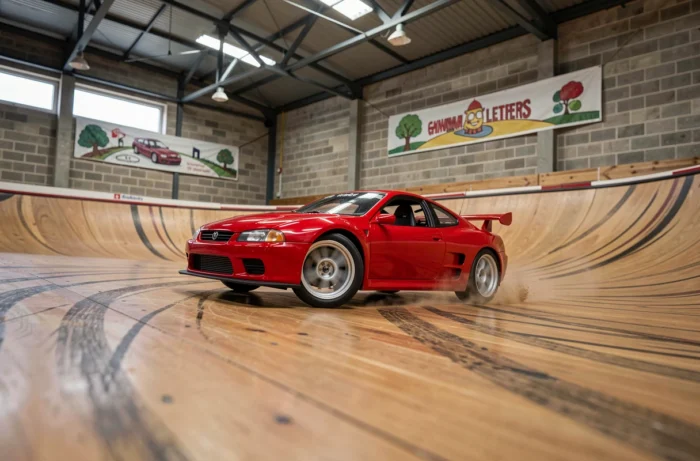
Vendée hosts several formats of RC races, from friendly gatherings to structured regional championships. Mini-Z races, these small indoor RC cars at 1/28 scale, have recently gained visibility in the department with events aimed at democratizing modeling for a family audience.
Off-road crawling outings (crawler, scale, short course, U4) are regularly organized by local groups throughout the Vendée region. These gatherings often take place on natural terrains, with courses laid out for the occasion.
- Races on asphalt or dirt tracks follow a format of qualifications and heats, similar to full-scale motorsport
- Crawler outings are practiced without a timer, with a judgment on the ability to overcome obstacles without assistance
- Indoor Mini-Z events allow for racing all year round, regardless of Vendée’s weather
Local community life plays a central role. Clubs welcome beginners, lend equipment during discovery days, and maintain the tracks. Without these volunteer structures, the practice would remain isolated and hard to access.
RC modeling in Vendée combines technique, patience, and friendliness. Whether you prefer the speed of a Traxxas Slash on the track or the precision of a TRX-4 in crawling, the true common point remains the pleasure of adjusting, driving, and sharing.